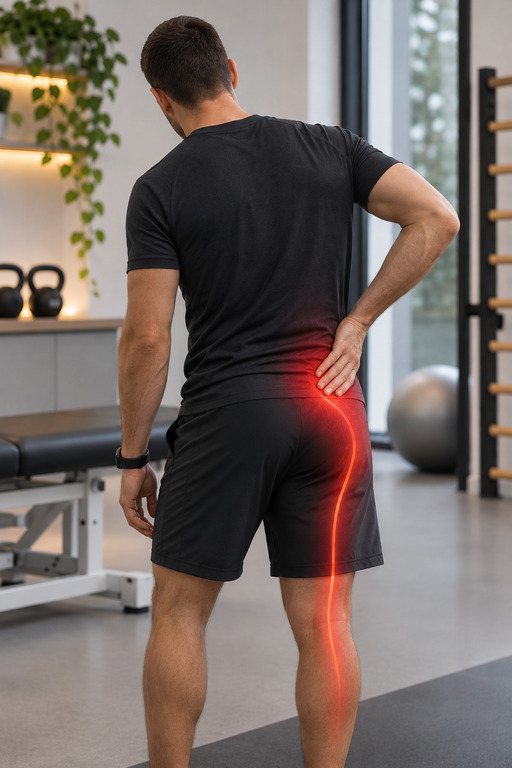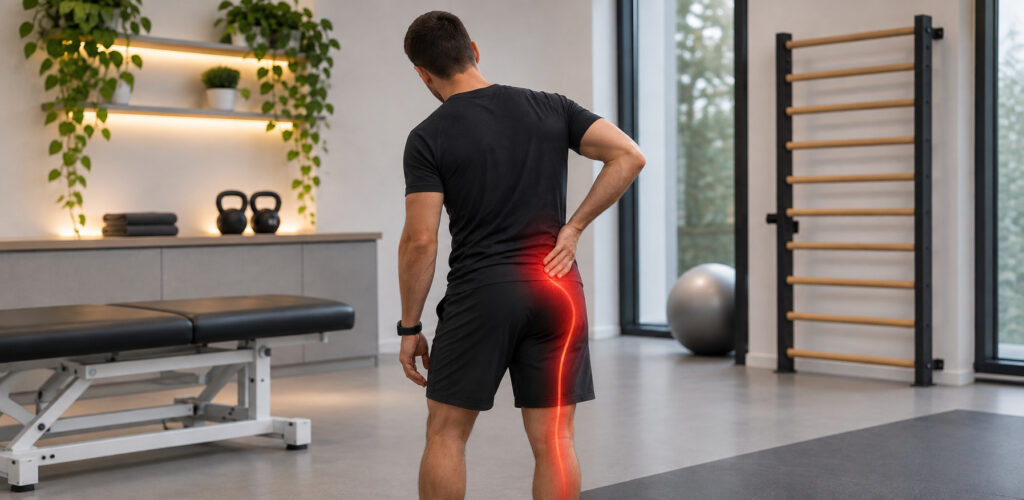
Sciatica is pain that travels from the lower back or buttock down the leg, often below the knee and sometimes into the foot. People describe it as pulling, burning or electric, and it often comes with pins and needles or numbness. In most cases it is caused by an irritated nerve root in the lower (lumbar) spine, most commonly because of a herniated disc, sometimes called a slipped disc.
For most people, sciatica improves considerably within a few weeks, without surgery. Bed rest does not help. Staying active and doing the right exercises usually gets you back to daily life, work and sport sooner.
A few warning signs do need urgent attention, such as numbness around the genitals or problems passing urine. Below you will find what they are, which sciatica exercises help, and how we treat sciatica at our clinic in Zurich Altstetten.
In short: Sciatica is radiating leg pain, usually caused by a herniated disc irritating a nerve root in the lower back. Most cases improve within a few weeks. What works best is staying active and doing targeted exercises, supported by physiotherapy. If you have numbness around the genitals or buttocks, bladder or bowel problems, or increasing weakness in your leg, go to an emergency department straight away.
Sciatica: What Is Going On?
In true sciatica, one of the nerve roots that form the sciatic nerve is irritated. The sciatic nerve is the thickest nerve in the body. It is formed by several nerve roots from the lumbar spine and sacrum (L4 to S3), runs through the buttock and down the back of the thigh, and splits into two branches just above the back of the knee to supply the lower leg and foot.
Doctors call it lumbar radiculopathy: pain that follows the path of a nerve root and is often worse in the leg than in the back. That is what sets it apart from ordinary back pain, which can spread into the buttock or thigh but rarely past the knee.
Typical sciatica symptoms besides the leg pain include:
- pins and needles or numbness in a specific patch of skin on the lower leg or foot
- pain that shoots down the leg when you cough, sneeze or strain
- symptoms that get worse with long periods of sitting or bending forward
- sometimes weakness, for example when lifting your big toe or walking on your heels or tiptoes
When you come to us for physiotherapy in Altstetten, the first job is to find out whether a nerve really is involved, or whether the pain comes from joints and muscles in the back, pelvis or hip.
For a general overview of symptoms and self-care, see also the NHS guide to sciatica.
What Causes Sciatica?
Most often it is a herniated disc in the lower back. In older adults, a narrowing of the spinal canal is a more common cause. Other causes are much rarer.
Herniated Disc
The discs sit between the vertebrae as shock absorbers. If material from the centre of a disc pushes out backwards, it can press on a nerve root and irritate it chemically. The levels most often affected are L4/L5 and L5/S1, and it is most common between about 30 and 50. It may start after lifting or twisting, after a few days of back pain, or with no obvious trigger at all. Many herniations shrink over time as the body breaks down the material.
Spinal Stenosis
From around 60, the spinal canal can narrow as ligaments, joints and discs thicken. Typical signs are pain, heaviness or tingling in one or both legs when walking or standing, which ease when you sit down or bend forward. Many people notice they can walk further leaning on a shopping trolley, or that cycling is easier than walking.
Spondylolisthesis
Here one vertebra slips forward on the one below. This can narrow the space for a nerve root and cause leg pain, often together with back pain that is worse when arching the back or under load.
Piriformis Syndrome
The piriformis is a muscle deep in the buttock, and the sciatic nerve runs underneath it. If the muscle is irritated, it may press on the nerve, causing buttock pain that is worse when sitting and spreads into the thigh. How common piriformis syndrome really is remains debated, so we only consider it once the lower back is an unlikely source.
Sciatica in Pregnancy
Many pregnant women feel pulling pain in the buttock and leg. Usually it comes from the pelvis, meaning the sacroiliac joints and ligaments, rather than from a trapped nerve. A true disc herniation during pregnancy is rare. Physiotherapy with adapted exercises and advice on sleeping positions and daily activities helps in either case.
Rare Causes
Very occasionally, an infection, a tumour, a fracture or a disease of the nerve itself is behind it. Clues include fever, unexplained weight loss, a history of cancer, a weakened immune system or long-term cortisone use, an accident, or pain at rest and at night that keeps getting worse. These need a medical assessment.
Which Cause Matches Your Symptoms?
Where the pain is and what makes it worse give useful first clues. This overview cannot replace an examination.
Pain below the knee or into the foot
- Leg pain worse than back pain, often with pins and needles, worse when sitting, coughing or sneezing: typical of an irritated nerve root, usually from a herniated disc.
- Pain, heaviness or tingling in one or both legs when walking, easing when you sit: more likely spinal stenosis.
Pain in the buttock and thigh
- Deep buttock pain, worse when sitting, not spreading below the knee: often from the sacroiliac joint, the glute muscles or, less often, piriformis syndrome.
- Pain in the groin and outer hip: more likely the hip, which is why we always examine it too.
Pins and needles, numbness and weakness
- Tingling or numbness in a clearly defined area of the lower leg or foot: points to a specific nerve root.
- Foot slapping down when walking, difficulty walking on your heels or tiptoes: weakness from the nerve root. See a doctor promptly.
Red flags for an emergency
- Numbness around the genitals or buttocks, problems passing urine or controlling your bowels: possible cauda equina syndrome. Go to an emergency department immediately.
- Leg pain with fever, weight loss or a history of cancer: see a doctor promptly.
- New pain, numbness or increasing weakness in both legs: possible cauda equina syndrome. Go to an emergency department immediately.
Sciatica When Sitting, at Night, Walking and in Sport
When the pain comes on often says more about its cause than where it hurts. So at your first appointment we ask about your desk, your commute, how you sleep and what training you do.
Sciatica When Sitting and Driving
Slumped sitting, for example in a low sofa or a car seat, increases pressure on the discs. If you work from home or commute a long way, the leg pain is often worst in the evening. Short walking breaks every 20 to 30 minutes, switching between sitting and standing, and a small cushion in the small of your back usually help. On long drives, stop once an hour.
Sciatica at Night: The Best Sleeping Position
Many people find lying on their back with their lower legs raised most comfortable, hips and knees at roughly a right angle on a chair or a large cushion. If you sleep on your side, put a pillow between your knees. Severe pain in the first few days is common. If night pain keeps getting worse over several weeks and no position helps, have it checked.
Leg Pain When Walking
If pain, heaviness or tingling in your legs forces you to stop after a few hundred metres and settles quickly when you sit or bend forward, spinal stenosis is a likely cause. Narrowed leg arteries can cause similar symptoms, and your doctor will tell the two apart.
Lumbago or Sciatica?
Lumbago and other acute back pain come on suddenly, with severe pain in the lower back, often when bending or lifting. Lumbago usually stays in the back and settles within days to a few weeks. With an irritated nerve root, the leg pain is the main problem. Sometimes it follows a bout of lumbago if a disc herniation develops.
Should I Walk, Run or Cycle With Sciatica?
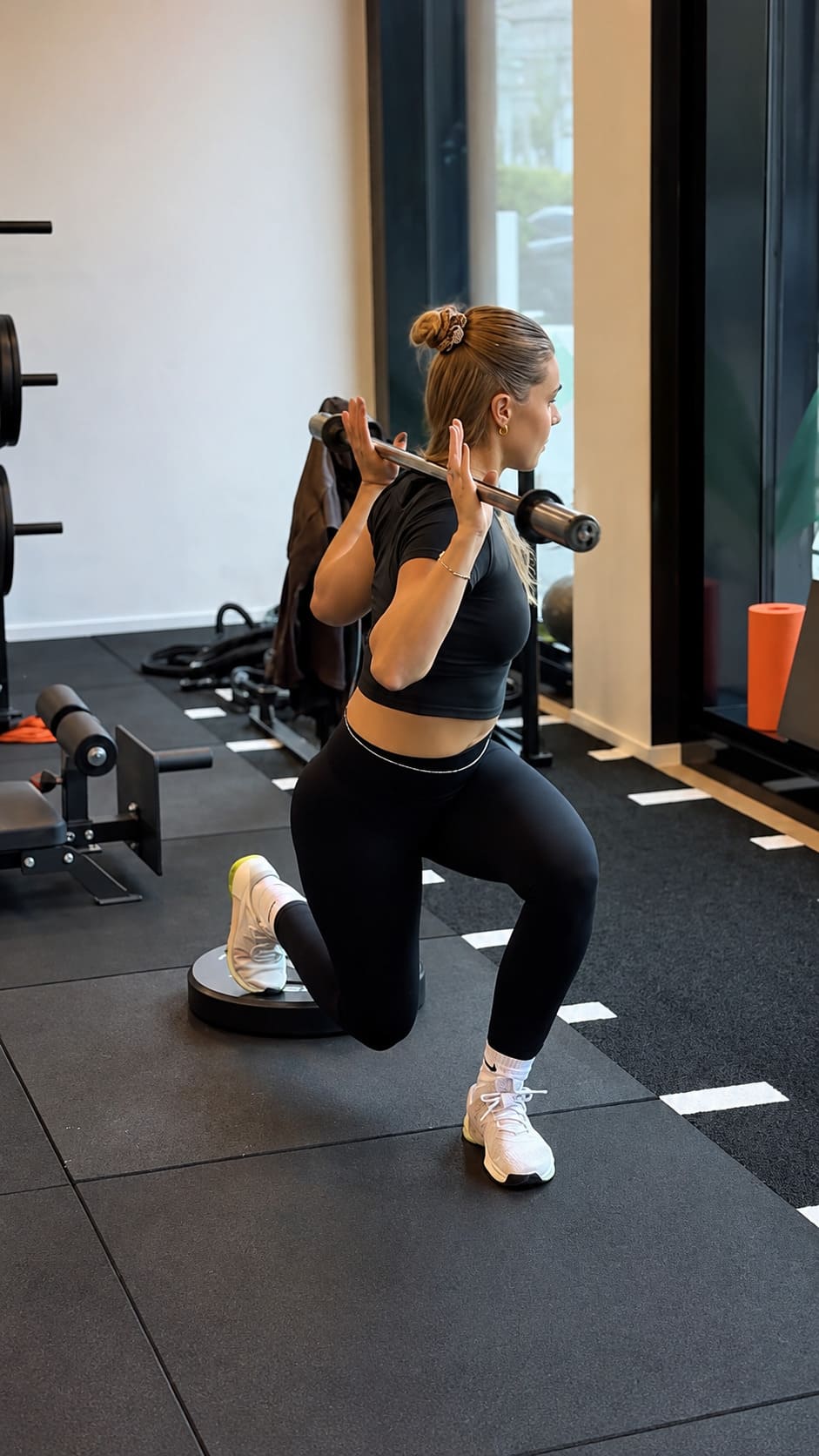
Walking is one of the best things you can do. You rarely have to give up sport completely. In the early phase, walking, easy cycling or swimming are usually better tolerated than running, heavy squats or deadlifts. With sports physiotherapy, we plan your return to hard training step by step, using exercises and loads the irritated nerve can cope with.
Sciatica: When to See a Doctor or Physiotherapist
Get sciatica checked if the leg pain is severe, has not improved after two to three weeks, or keeps coming back, or if it stops you sleeping or working. Physiotherapy can help at almost every stage. For basic insurance to pay, you need a prescription from a doctor or chiropractor.
See a doctor promptly if you notice:
- new weakness in your leg, for example your foot slapping down when you walk or being unable to stand on tiptoe
- numbness that is spreading
- leg pain with fever, unexplained weight loss or a history of cancer
- back pain after a fall, particularly if you have osteoporosis
Important: Go to an emergency department immediately if your leg pain comes with numbness around the genitals, buttocks or back passage (saddle anaesthesia), if you cannot hold or cannot pass urine, if you lose control of your bowels, if you can no longer feel urine passing normally, if you notice new changes in sexual function, or if pain, numbness or weakness newly appears in both legs. These can be signs of cauda equina syndrome, where the nerves at the bottom of the spinal canal are severely compressed. It is rare, but it needs treatment within hours. If you cannot get to hospital yourself, call 144, the Swiss emergency number.
Diagnosis: Do You Need an MRI for Sciatica?
Usually not in the first few weeks. A detailed history and examination are normally enough to recognise an irritated nerve root and narrow down which nerve root is involved. An MRI makes sense if there are warning signs, if weakness is getting worse, or if symptoms are still severe after about six weeks and an injection or surgery is being considered. Your doctor decides whether it is needed.
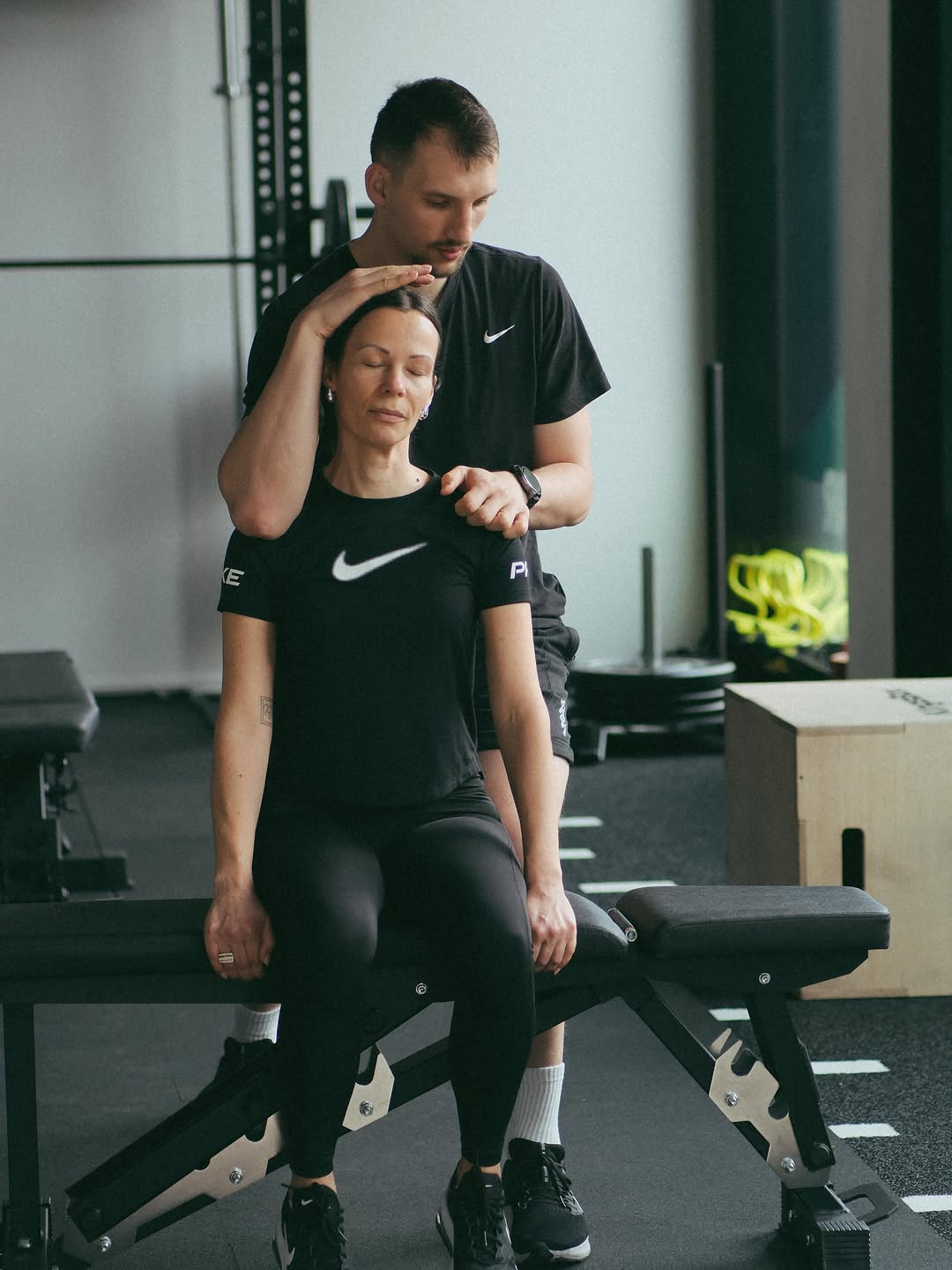
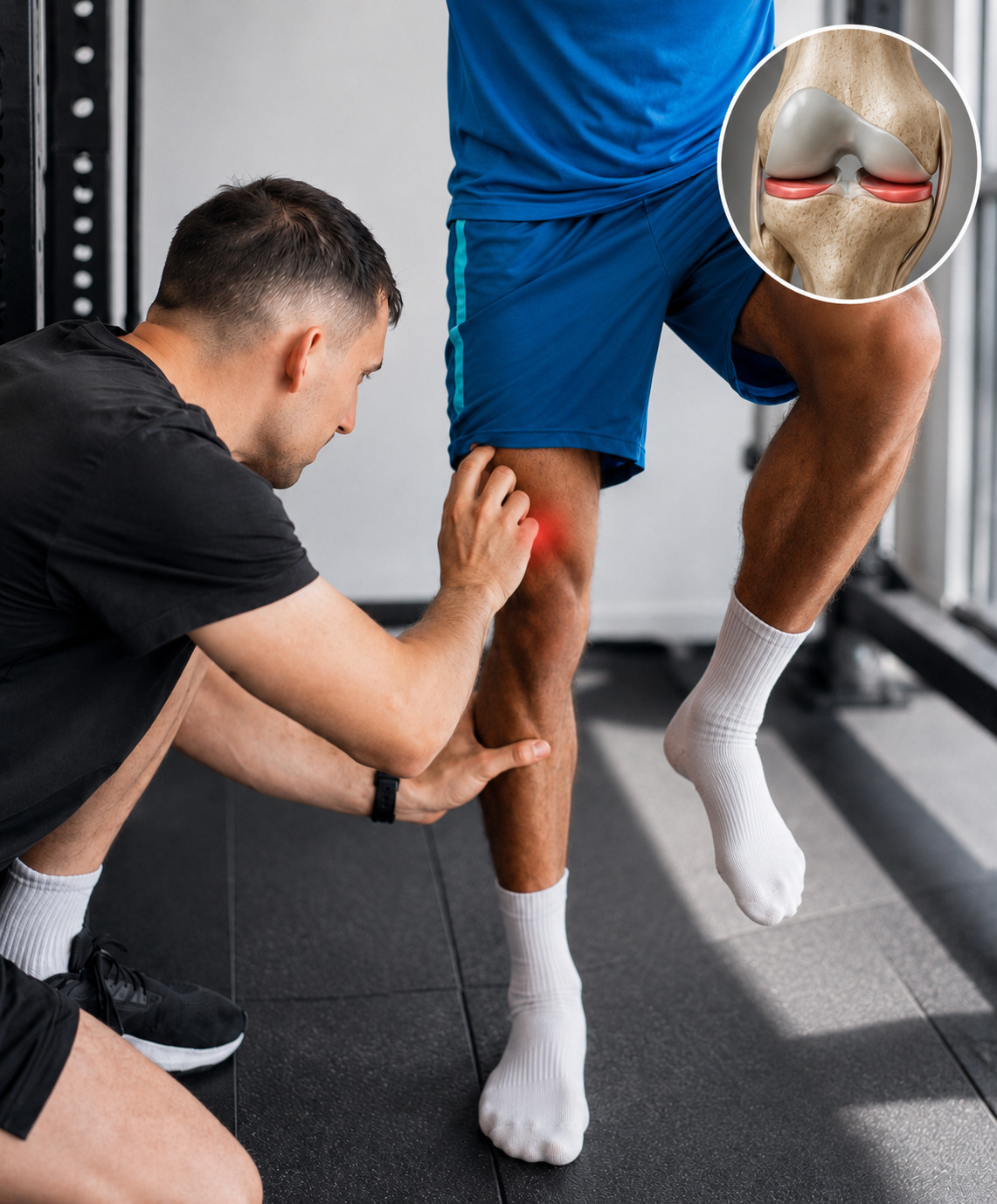
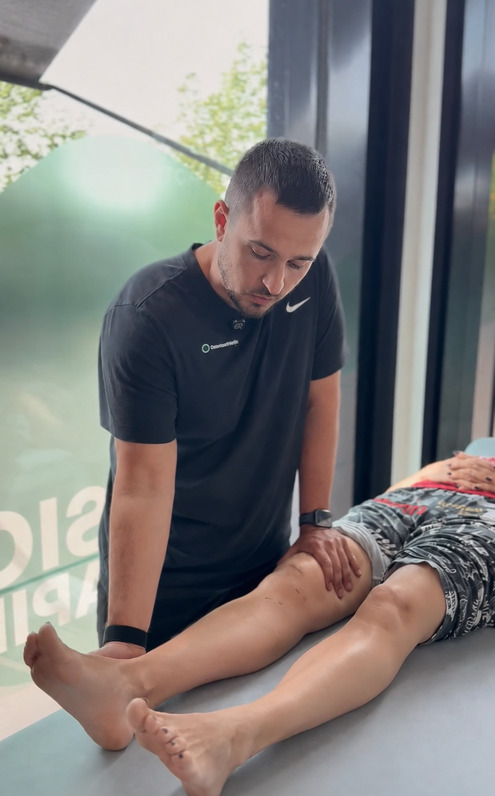
In physiotherapy, we test strength, sensation and reflexes in both legs, how your lower back moves, and how the nerve reacts to tension, for example when the straight leg is raised while you lie on your back. The pattern in the leg often shows which nerve root is affected:
L4 nerve root
Pain and altered sensation at the front of the thigh and the inner side of the shin. Weakness straightening the knee, for example on stairs. The knee reflex may be reduced.
L5 nerve root
Pain down the outside of the lower leg to the top of the foot and the big toe. Weakness lifting the big toe or foot, and walking on your heels is difficult. In marked cases the foot drops when walking.
S1 nerve root
Pain down the back of the thigh and calf to the sole and outer edge of the foot. Weakness standing on tiptoe. The ankle (Achilles) reflex may be reduced.
Referred pain without a nerve root
Pain from joints, ligaments and muscles in the back, the sacroiliac joint or the hip can also spread into the leg. It usually stays above the knee, does not follow a clear nerve pattern, and comes without weakness or reflex changes.
This is a guide, not a diagnosis. The skin areas overlap, and not every sign appears at once.
Injection or Surgery?
For very severe pain, an injection near the nerve root can give relief for a while and make it easier to start exercising. Surgery is mainly discussed for worsening weakness, for cauda equina syndrome, or for severe leg pain that has not improved after several weeks of consistent treatment. It can relieve pain faster, but after one to two years, results after early surgery and after initial non-surgical treatment were similar in a large Dutch trial (New England Journal of Medicine, 2007). You decide together with your doctor what suits your situation. After back surgery, we guide your rehab according to your surgeon’s protocol.
Good to know: Many people around 50 show disc bulges on an MRI even though they have never had sciatica. A scan finding on its own is therefore not an explanation. It only becomes meaningful when it matches the nerve root that stands out in your examination.
How Physiotherapy Helps With Sciatica
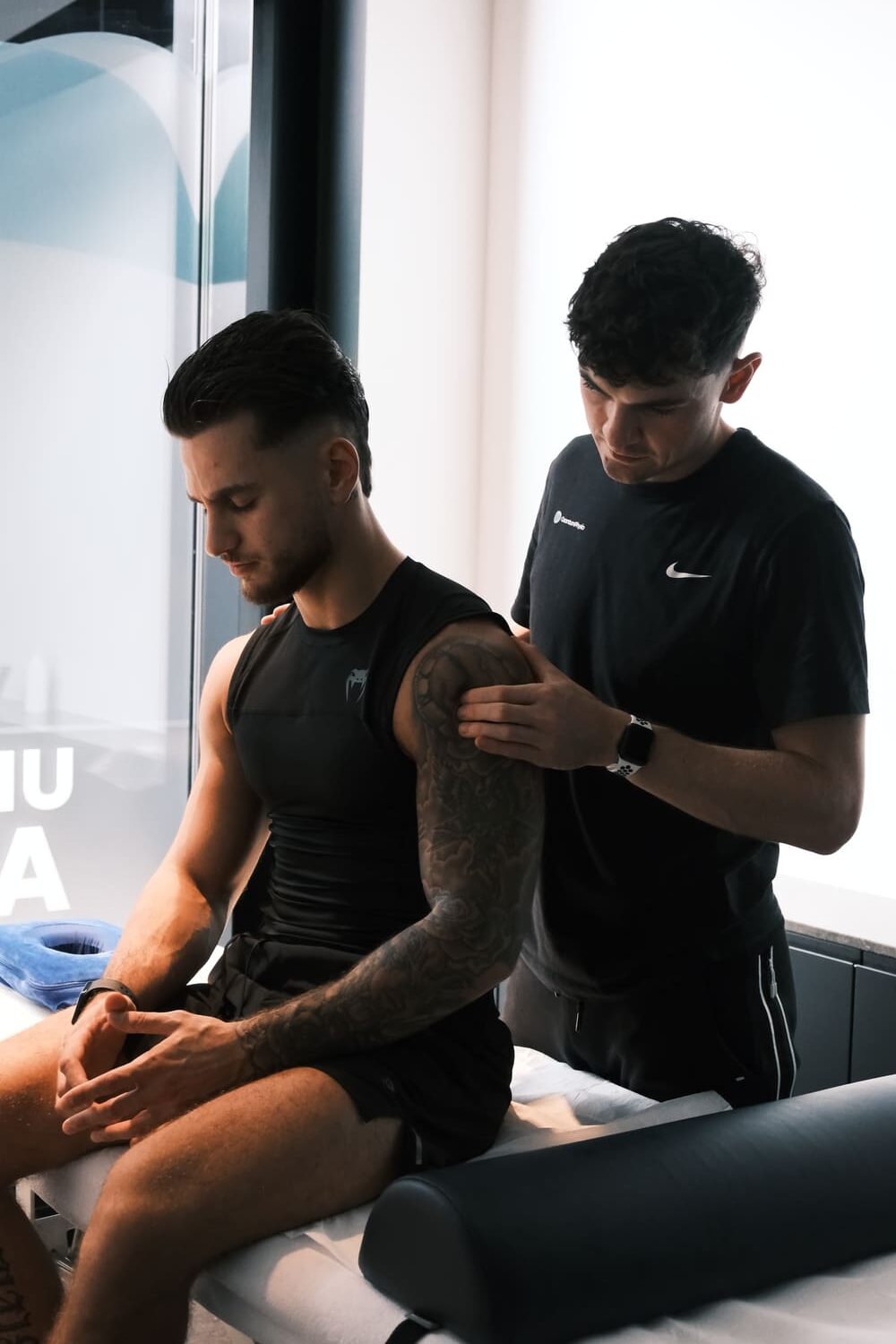
Physiotherapy for sciatica is built on movement and targeted exercise, with hands-on techniques where they make exercising easier. The UK NICE guideline NG59 recommends exercise programmes for low back pain with sciatica, and manual therapy only as part of such a programme. It advises against traction, ultrasound and electrotherapy such as TENS or interferential therapy for low back pain and sciatica. We explain why massage alone is rarely enough in Physiotherapy or Massage.
Depending on the stage, treatment usually includes:
- a clear explanation of what is happening and how much activity is right for now
- positions and movements that draw the leg pain back towards the spine
- nerve mobilisation, meaning gentle gliding movements for the irritated nerve
- manual therapy for the lower back, pelvis and hip
- strengthening for the trunk, glutes and legs with gradually increasing load
- adjustments for your desk, commute and sport
How Long Does Sciatica Treatment Take?
That depends on the cause and how things progress. For many people, leg pain improves clearly within two to four weeks. Pins and needles and numbness often take longer, sometimes months, and weakness usually recovers slowly. With spinal stenosis, the goal is less about a cure and more about being able to walk further again.
Sciatica Physiotherapy in Zurich at Quantum Physio
Most people who come to us with sciatica mainly want to know what happens next and when the leg pain will ease. That is why we start with a thorough examination of your back, pelvis, hip and nerves at our clinic in Altstetten. Our team of BSc- and MSc-qualified physiotherapists and sports therapists explain the findings and plan the coming weeks with you.
Treatment by Stage
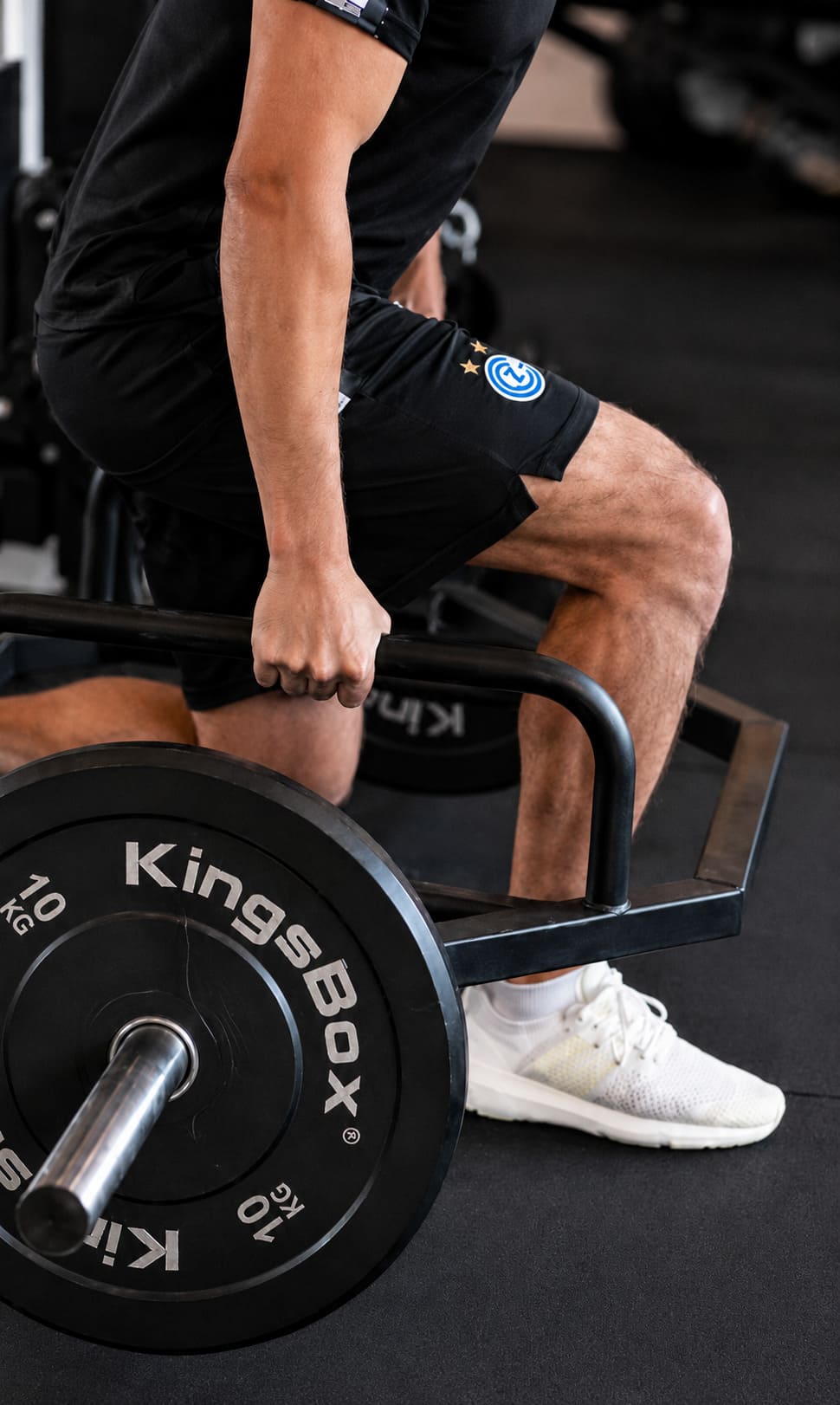
What we combine depends on the stage. In the first days, the focus is on pain relief, comfortable positions and gentle movement. After that come nerve mobilisation, manual therapy and an exercise programme that we continue on equipment in medical training therapy (MTT). If you want to get back to the gym or running, the final stage is strength training at full load.
New to Switzerland?
Physiotherapy is only covered by Swiss basic insurance with a prescription. If you do not have a family doctor yet, you can get a prescription from any GP, a walk-in clinic (in Zurich often called a Permanence) or a chiropractor. On a GP, HMO or Telmed policy, contact your first point of care before anyone else, including before seeing a chiropractor, otherwise your insurer may refuse to pay.
Early, Evening and Saturday Appointments
Leg pain like this rarely strikes at a convenient time. Our clinic on Vulkanstrasse 110a is a few minutes’ walk from Zurich Altstetten station, with appointments from 07:00 to 20:00 Monday to Thursday, until 16:30 on Fridays and from 08:00 to 14:30 on Saturdays, so therapy fits in even once you are back at work. Book a session online.
How Sciatica Treatment Works
From the first assessment to full load, we work in four steps.
1. Assessment
We ask how it started, how it has developed and what sets it off, then test strength, sensation, reflexes and how the nerve reacts. We also check for warning signs.
2. Your Treatment Plan
You learn what is behind your symptoms and what you can do yourself. Together we set goals, such as sitting for an hour again, commuting without pain or getting back to your running route.
3. Calm the Nerve, Build Strength
First we look for positions and movements that reduce the leg pain. As it settles, we strengthen your trunk, glutes and legs with increasing load.
4. Back to Daily Life and Sport
Finally, we practise exactly what you need in daily life, from lifting a box to sprinting. A home programme helps prevent it coming back.
Sciatica Exercises: 5 Simple Exercises for Home
These exercises are suitable if you have no warning signs and your pain did not start with an accident or fall. Keep an eye on your leg pain while you do them. If it moves back towards your spine or gets weaker, that is a good sign, even if your back feels a little more for a moment.
Stop if the pain spreads further down the leg or clearly increases, pins and needles or numbness increase, your leg gets weaker or you feel dizzy, and have it checked. After back surgery, only exercise once your doctor has cleared you. If you are pregnant, leave out lying on your front and avoid long periods on your back from the second trimester; we adapt the exercises for you.
1. Relief Position (90/90)
Aim: to calm the irritated nerve, especially in the first few days.
How: Lie on your back with your lower legs resting on a chair or a stack of cushions, so your hips and knees are bent at roughly a right angle. Breathe slowly into your belly.
Dose: 5 to 10 minutes, several times a day, ideally between walks.
2. Walking in Short Bouts
Aim: to keep moving without overloading the nerve.
How: Walk at a comfortable pace on level ground, little and often rather than one long walk. Increase the time day by day as long as the leg pain does not get worse.
Dose: start with 5 to 10 minutes, 3 to 4 times a day.
3. Lying on Your Front and Propping on Your Elbows
Aim: with many disc problems, to bring the leg pain back towards the spine.
How: Lie on your front for a few minutes. If that feels fine, prop yourself up on your forearms with your elbows under your shoulders, letting your stomach relax onto the floor. Stay there as long as it is comfortable. If the leg pain gets worse or spreads further down, leave this exercise out. With spinal stenosis it is often uncomfortable.
Dose: hold for 1 to 2 minutes, 3 to 5 times, several times a day.
4. Seated Nerve Glide
Aim: to move the sciatic nerve gently without stretching it.
How: Sit upright on a chair. Slowly straighten the knee of the affected leg and pull your toes towards you while tipping your head back to look up. Then bend the knee again and bring your head down at the same time. The movement should be smooth and barely pull.
Dose: 10 repetitions, 2 to 3 times a day. Only go as far as you can without the leg pain increasing.
5. Glute Bridge
Aim: to strengthen your glutes and trunk once the acute pain eases.
How: Lie on your back with your knees bent and feet hip-width apart on the floor. Press your heels down and lift your hips until your shoulders, hips and knees form a line. Hold briefly, then lower slowly.
Dose: 3 sets of 10 repetitions, every other day.
Which exercises suit you depends on the cause. In physiotherapy, we build your programme around the findings and progress it, later for example in medical training therapy in Zurich.
Four Myths About Sciatica
Most of these myths lead people to rest too much or stretch too hard.
“Sciatica means bed rest.”
Bed rest brings no advantage over staying active with sciatica, and long periods lying down have downsides of their own. A day or two of lying down a lot is fine when the pain is very bad. After that, staying as normally active as you can is what helps.
“A herniated disc means surgery.”
Most disc herniations are treated without surgery, and many shrink on their own. Surgery is mainly considered for weakness, bladder or bowel problems, or very persistent leg pain.
“The nerve is trapped and needs to be put back.”
Usually, the nerve is mainly irritated and inflamed. No single manipulation fixes that. Manual therapy can ease pain and make movement easier, but improvement comes with time and exercise.
“The harder I stretch, the faster it goes.”
Many people stretch too hard. An irritated nerve does not like it, and strong hamstring stretches can make the pain worse. Gentle nerve glides are usually better tolerated.
Sciatica Relief at Home: What Helps?
If there are no warning signs, there is a lot you can do yourself:
- stay active, with short walks spread over the day or easy cycling
- break up long periods of sitting and stand up regularly
- use relief positions such as the 90/90 position when the pain flares
- use heat on the lower back or buttock if it feels good
- leave out heavy lifting, deadlifts and deep squats for a while
- ask your doctor or pharmacist about pain relief
Two to three weeks without real progress, or flare-ups that keep returning, are the point to get it assessed rather than carry on alone.
Common Mistakes That Make Sciatica Last Longer
We most often see two extremes: resting for weeks out of fear, or carrying on training unchanged despite worsening leg pain. Other common mistakes:
- sitting for hours without a break, at a desk or in the car
- stretching the painful leg hard
- relying only on injections, massage or painkillers
- going straight back to your old weights once it settles
- not getting new leg weakness checked
What Sciatica Physiotherapy Costs and What Swiss Health Insurance Pays
With a doctor’s prescription, Swiss basic health insurance covers physiotherapy, minus your deductible (franchise) and co-payment. You can read how billing and treatment work with us in Physiotherapy in Zurich Altstetten: treatment and costs.
With a medical prescription
Swiss basic health insurance (KVG/LAMal) usually pays, provided a doctor or chiropractor has prescribed the physiotherapy. Your share is the deductible you chose plus 10% of the remaining cost, up to CHF 700 a year for adults. One prescription is good for up to nine sessions, and with a first prescription, treatment has to start no later than five weeks after it was issued.
If the pain followed an accident, such as a fall, report it to your employer or insurer. Employees may then be covered by accident insurance (UVG, e.g. Suva), with no deductible or co-payment. Whether a herniated disc counts as the result of an accident is decided case by case by the accident insurer.
Without a medical prescription
Booking without a prescription is fine too. You then pay the bill yourself, and some supplementary policies refund part of it.
Training, rehabilitation and prevention
After therapy, many people benefit from training that keeps the back resilient in the long run, such as medical training therapy or mobility training. Medical training therapy can be covered by basic insurance with a prescription. Training without a prescription is billed separately.
Frequently Asked Questions About Sciatica
What helps sciatica quickly?
Keep moving, break up long periods of sitting, and when the pain is bad, lie on your back with your lower legs on a chair (the 90/90 position). Many people find heat helpful. Ask your doctor or pharmacist about pain relief. Bed rest is not a good idea.
How long does sciatica last?
For most people, the leg pain improves considerably within a few weeks. Pins and needles, numbness or weakness can last longer, sometimes several months. If the pain is still severe after six weeks, your treatment should be reviewed by a doctor.
Can sciatica go away on its own?
Often, yes. Many disc herniations shrink over time, and the nerve settles. Staying active and doing the right exercises supports this process. Warning signs such as weakness or bladder problems still need prompt medical attention.
What are the best exercises for sciatica?
Good starting points are short walks, the 90/90 relief position, lying on your front propped on your elbows, a seated nerve glide and, later, the glute bridge. What matters is how your leg responds: if the pain moves back towards your spine, the exercise suits you; if it spreads further down, leave it out.
Does physiotherapy help sciatica?
Yes. Guidelines recommend exercise programmes for it, supported by manual therapy where useful. Physiotherapy helps you understand the pain, find the right movements and rebuild strength and resilience.
When should I see a doctor about sciatica?
Promptly if you have new leg weakness, spreading numbness, fever, or a history of cancer. Go to an emergency department straight away if you have numbness around the genitals or buttocks, problems passing urine or controlling your bowels, new changes in sexual function, or new symptoms in both legs.
What are the warning signs of cauda equina syndrome?
Numbness around the genitals, buttocks or back passage, difficulty passing or holding urine, loss of bowel control, changes in sexual function, and new pain, numbness or weakness in both legs. These need emergency treatment within hours. In Switzerland, the emergency number is 144.
Does a herniated disc with sciatica need surgery?
Usually not. Most disc herniations are treated without surgery, and many shrink on their own. Surgery is discussed for worsening weakness, cauda equina syndrome, or severe leg pain that has not improved after several weeks of treatment.
Do I need an MRI for sciatica?
Usually not in the first few weeks. An MRI makes sense if there are warning signs, if weakness is getting worse, or if an injection or surgery is being considered after about six weeks.
Should I walk with sciatica?
Yes, walking is one of the best things you can do. Go little and often on level ground and build up the time gradually, as long as the leg pain does not get worse.
What is the difference between sciatica and piriformis syndrome?
Sciatica usually comes from a nerve root in the lower back. In piriformis syndrome, a muscle deep in the buttock irritates the sciatic nerve, typically causing buttock pain that is worse when sitting. Piriformis syndrome is less common, so the lower back should be checked first.
What helps sciatica in pregnancy?
The pain usually comes from the pelvis rather than the nerve. Adapted exercises, advice on sleeping positions and daily activities, and sometimes a pelvic support belt help many women. From week 13 of pregnancy until eight weeks after birth, you pay no deductible or co-payment under Swiss basic insurance. Numbness around the genitals or bladder problems are an emergency in pregnancy too.
Does Swiss health insurance cover physiotherapy for sciatica?
Yes, if a doctor or chiropractor prescribes it. Each prescription covers up to nine sessions. Your share is the deductible plus 10%, with the 10% capped at CHF 700 a year for adults. Without one, you pay privately and may claim part from supplementary insurance if your policy includes physiotherapy.
Where can I get sciatica physiotherapy in Zurich?
Our clinic is on Vulkanstrasse 110a, a few minutes’ walk from Zurich Altstetten station. We combine a thorough examination, nerve mobilisation, manual therapy and an exercise programme through to your return to daily life and sport. We see patients from 07:00 to 20:00 Monday to Thursday and until 14:30 on Saturdays.